

- Summary
- What is Standard Work for Leaders?
- The Roots in the Toyota Production System
- The three levels of Standard Work for Leaders
- Why does a leader's work often remain invisible?
- Why Standard Work Leadership is the Engine of Change
- A Day in the Life of a Team Leader
- How to build the Standard Work Leader template
- How to classify activities inside and outside LSW
- What benefits does Standard Work bring?
- Frequently Asked Questions about Standard Work Leadership
- What is Leader Standard Work and what is it for?
- Leader Standard Work is a structured approach to managing daily operations and tasks, ensuring consistency and predictability. It typically includes predefined routines, metrics, and problem-solving methods for leaders. A simple agenda, on the other hand, is a list of tasks or topics to be addressed, often without a prescribed method or structure for execution.
- Who should implement Leader Standard Work in the company?
- How do you build a Standard Work Leader template?
- Leader Standard Work brings concrete results such as improved team performance, increased efficiency, better problem-solving, enhanced employee engagement, and consistent operational standards.
- How to implement Standard Work for Leaders with Bonfiglioli Consulting
By the Editorial Staff of Bonfiglioli Consulting
Every publication stems from industry studies, field research, and global trend analysis, integrated with the knowledge and expertise gained from transformation projects, with the aim of promoting a business culture.
Published 07/20/2026
Summary
The Leader Standard Work (LSW) is the managerial system that transforms daily Lean leadership practices into observable, measurable, and improvable routines. Born within the Toyota Production System, Then LSW answers a concrete question: why do many companies that copy Lean tools — kanban, continuous flow, heijunka — not achieve the same results as Toyota? The answer lies in how leaders manage their time and their priorities every day.
In this article, you will discover What is Standard Work Leadership?, what are its three levels (activity, procedures, and standard thinking), how to build an effective template, and what benefits it brings to your organization. You will also explore the typical day of a Team Leader, the criteria for classifying tasks to be included in the LSW, and how to concretely measure adherence to it. A complete path for those who want to move from reactive management of emergencies to a Structured, disciplined, and continuous improvement-oriented Lean leadership.
Thousands of managers and consultants have visited Toyota's facilities hoping to discover the “secret” of Lean, but focusing almost exclusively on tools like Kanban, continuous flow e Heijunka. Only when organizations that had copied these very tools achieved mediocre results was a fundamental point understood: Lean is not a set of tools, but a management culture that passes through the Leader Standard Work (LSW), the system that makes daily leadership practices systematic and measurable.
What is Standard Work for Leaders?
What visitors to Toyota couldn't see were the management practices that leaders put into place every day to build and maintain a genuinely Lean environment. A Lean culture isn't built simply by training employees on tools; it requires a change in how leaders manage their own time and priorities. The practices that form the true engine of problem-solving in a Lean organization include three recurring elements:
- Regular and structured group meetings
- Gemba Walk, or process visits by leaders in the field
- Employee coaching for autonomous problem-solving
Standard Work Leader is not just a schedule: It is a managerial system that transforms the leader's work in an observable, replicable, and improvable practice, making these practices systematic instead of leaving them to the good will of individual managers.
The Roots in the Toyota Production System
To understand the role of Standard Work Leader, it's useful to place it among the 14 keys that describe the management philosophy of Toyota Production System (TPS), principles that don't just concern production but the way a Lean company thinks, decides, and organizes itself over time. The Lean Enterprise Institute, an international academic reference on the subject, emphasizes how Leader Standard Work is the discipline that makes these principles practically applicable, not an optional addition to Lean leadership.
Among the most relevant principles for leadership are:
- Base decisions on long-term choices, not on short-term financial horizons
- Create a continuous flow of a process to surface problems, rather than hide them
- Balance the workload across’Heijunka, working as much as needed without chasing efficiency for its own sake
- Build quality in at every stage of the process, stopping if necessaryjidoka)
- Standardize processes and activities as the basis for continuous improvement
- To grow leaders who know field work, understand its philosophy, and are capable of teaching it.
- Verify things for yourself, according to the principle of Go and see for yourself
- Transform the organization into a system that reflects on its mistakesreflection) and continuously learns (continuous improvement)
The principle of standardization is the one from which Leader Standard Work most directly derives: without a clear standard in the way leaders manage their time, it becomes impossible to identify deviations, Measure improvements and replicate best practices.
The three levels of Standard Work for Leaders
An effective Standard Work Leader acts on three complementary levels, which together they ensure process stability, people development and alignment with business priorities:
- Standard activitiesdaily, weekly, monthly, quarterly, and annual tasks that set the leader's work rhythm
- Standard procedurestandardized agendas, escalation mechanisms, reporting, and tools such as Kamishibai for visual verification of standards
- Standard thoughtcoaching, guiding questions, application of Lean principles, and cause-and-effect logic in problem-solving
This approach applies to every formal leadership role in the company, from department team leader to plant manager, and includes recurring activities such as operational meetings, audits, coaching, Gemba Walks, and improvement projects. The focus is twofold: on the one hand, production processes, and on the other, support for projects that span the entire organization.
Why does a leader's work often remain invisible?
In many organizations, a leader’s work remains implicit, variable, and largely invisible: too many activities are managed reactively, without clear standardization, making it more difficult to monitor compliance with standards and support continuous improvement. A guiding principle in this area is as simple as it is effective: if a standard hasn’t changed in a long time, the organization is likely not improving continuously. The role of a leader is precisely to encourage the adoption of new standards, verify their implementation in the field, and ensure that each Kaizen initiative, in turn, establishes a new standard.
Why Standard Work Leadership is the Engine of Change
The Standard Work Leader is defined as the true engine of organizational change for four reasons.
Check for improvements. The “You Care” principle consists of allowing leaders to perform routine tasks with minimal expenditure of mental energy. When recurring activities are standardized, the leader frees up cognitive energy to be dedicated to identifying and solving problems.
Learning by doing. Operational excellence is more about what you actually do than what you know in theory: real learning comes from direct experience following the disciplined application of Standard Work Leadership.
Raise the standard. As processes change and people learn, LSW must also evolve accordingly. It's no coincidence that the first Leader Standard Work is often described as “self-compiling”: it arises from an initial attempt that is continuously reviewed and adapted based on field experience.
Observe the anomalies. The fourth pillar concerns the ability to observe abnormalities and waste through consistent Gemba walks, encouraging leaders to be present on the ground, ask questions, and actively support people in their improvement journey.
A Day in the Life of a Team Leader
To make the concept concrete, it's useful to look at how Standard Work is translated into daily practice. A typical day for a production Team Leader is marked by specific and recurring moments:
- Shift start meeting
- Planning of Available Resources
- Operational briefing with the team
- Line Anomaly Management
- Meetings with Support Functions
- Training sessions
- Periodic audits
- Structured End to the Day
This sequence transforms the role of the leader into a a structured and clear routine, in which each step has a defined purpose and an associated standard time. Leader Standard Work can also be measured precisely: in an industrial implementation project, monitoring the leader’s adherence to planned activities resulted in a score of 97%, confirming that Leader Standard Work is not merely a qualitative tool for time management, but a system that can be defined, monitored, and improved with the same discipline applied to production processes.
How to build the Standard Work Leader template
The Leader Standard Work template is divided into two main sections: The activities section and the follow-up section.
In the Activities Section Fill out the column for standard activities, indicating their frequency, timing—for activities with a cycle longer than one day—and the expected standard time, estimating it if it is not yet known. Standard activities typically include meetings and related preparations, periodic events, routine office tasks, and Gemba Walks. An important constraint: standard activities should not exceed 50% of the leader’s total available time, leaving room for sporadic activities recorded in a dedicated section.
In the follow-up section, scheduled appointments are distributed on a template – nowadays increasingly digital, via mobile apps or dedicated dashboards rather than just Excel spreadsheets – organized on a monthly scale, divided into weeks and days. Updates ideally happen in real-time, also through automatic notifications or QR scanning, thus transforming every activity into either executed, not done, canceled, or unnecessary. The cycle is completed through three levels of monitoring: weekly planning, monthly tracking, and a continuously updated adherence dashboard, which has largely replaced traditional end-of-month reporting.
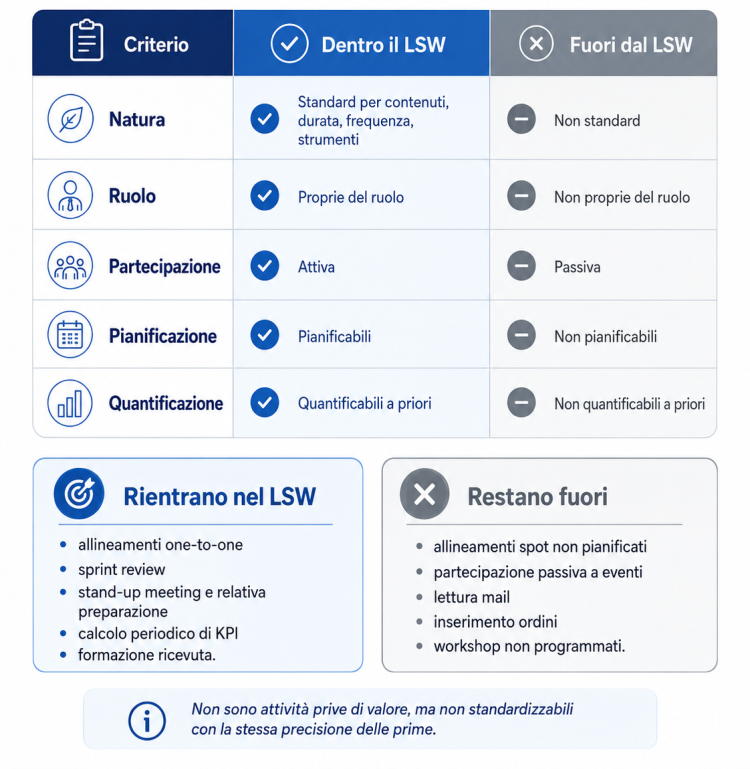
How to classify activities inside and outside LSW
Distinguishing which activities fall within the standard and which fall outside follows precise criteria.
What benefits does Standard Work bring?
Standard Leader Work guides leaders in more effective time management and provides senior managers with a concrete tool to balance employees' workloads, identifying imbalances before they become performance issues. Standardizing leadership work means shifting the focus from reactive crisis management to the daily building of discipline, learning, and continuous improvement—a theme also explored in our article on who truly drives continuous improvement.
Frequently Asked Questions about Standard Work Leadership
What is Leader Standard Work and what is it for?
Leader Standard Work (LSW) is a management system that standardizes daily Lean leadership practices, making them observable, measurable, and improvable. It transforms the leader's work (often implicit and variable) into a disciplined routine that includes structured meetings, Gemba Walks, and coaching of employees, freeing up cognitive energy for problem-solving.
Leader Standard Work is a structured approach to managing daily operations and tasks, ensuring consistency and predictability. It typically includes predefined routines, metrics, and problem-solving methods for leaders. A simple agenda, on the other hand, is a list of tasks or topics to be addressed, often without a prescribed method or structure for execution.
Unlike a common planner, the Standard Work Leader is not just a list of appointments: it is a structured three-level system (standard activities, standard procedures, and standard thinking) that guides the leader in time management, people support, and the consistent application of Lean principles. Each activity has a cyclicity, timing, and associated standard time, and is monitorable through dedicated dashboards.
Who should implement Leader Standard Work in the company?
Standard Work Leadership applies to every formal leadership role, from department team leader to plant manager. It is not a tool reserved for top management; on the contrary, it is all the more effective the more it is consistently applied at all hierarchical levels, creating an aligned and transparent management system.
How do you build a Standard Work Leader template?
A Leader Standard Work template is divided into two main sections: the activities section, which lists recurring tasks along with their frequency and estimated standard time, and the follow-up section, where appointments are scheduled on a monthly calendar—which is increasingly digital these days—and updated in real time. Standard activities should not exceed 50% of the leader’s total available time, leaving room for managing unplanned activities.
Leader Standard Work brings concrete results such as improved team performance, increased efficiency, better problem-solving, enhanced employee engagement, and consistent operational standards.
Leader Standard Work delivers measurable benefits: more effective time management, greater visibility into employees’ workloads, and the ability to shift from a reactive approach to managing urgent matters to a leadership style focused on continuous improvement. In an industrial case study documented by Bonfiglioli Consulting, monitoring adherence to LSW resulted in a score of 97%, demonstrating that Leader Standard Work is a system that can be defined, measured, and improved using the same discipline applied to production processes.
How to implement Standard Work for Leaders with Bonfiglioli Consulting
Introducing Leader Standard Work requires a gradual approach: map existing activities, build an initial template to test in the field, refine it through repeated cycles of observation and correction, consistent with the principle of “first LSW in self-compilation.” Bonfiglioli Consulting integrates Leader Standard Work into the process. Lean Champion Certification Program, by combining method, training, and hands-on presence at the Gemba.
If you wish to learn more about how to build a Standard Work Leader tailored to your organization, contact the Bonfiglioli Consulting team for an assessment of your current context and the areas for improvement in your leaders' time management.
