



Lean Production: The Art of Producing Value Without Waste
The Lean Production, lean manufacturing, is the beating heart and origin point of Lean Thinking. Born from the insights of the Toyota Production System, this methodology has revolutionized how companies create goods, focusing on the systematic elimination of all forms of waste to maximize customer value. Today, Lean Production continues to be an indispensable strategy for businesses aiming for operational excellence, cost reduction, and increased competitiveness.
Applying Lean in production means looking at each stage of the process through a critical lens: What adds value to the product from the end customer's perspective? And what, on the other hand, represents waste that can be eliminated, reduced, or optimized? The answer to these questions is the key to creating smooth, efficient, and responsive production flows that meet real market needs.
The objectives of Lean Production
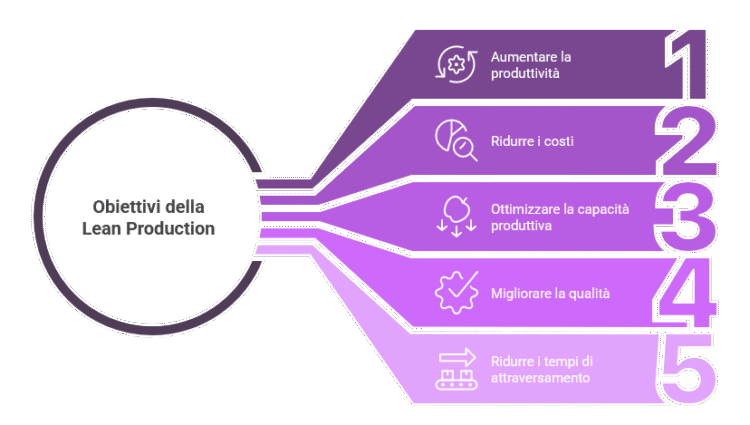
The implementation of Lean Production aims at several interconnected objectives, all aimed at improving company performance:
- Increase productivity
- Reduce costs
- Optimize production capacity
- Improve quality
- Reduce lead times (Lead Time)
Key Methodologies and Tools in Lean Production
To achieve these goals, Lean Production utilizes a suite of practical, often interconnected tools and methodologies:
- Value Stream Mapping (VSM)This visual tool is the starting point for analysis. It allows for mapping each step of the value stream, identifying value-added activities (VA), non-value-added activities (NVA), and critical points or bottlenecks. It enables the drawing of both the current situation (“As-Is”) and the desired future state (“To-Be”).
- Takt Timeis the “rhythm” of production, calculated based on customer demand. The goal is to balance the work content and product throughput time to meet this rhythm, ensuring that only what is required is produced.
- Five S (Sort, Set in Order, Shine, Standardize, Sustain): a fundamental method for organizing, cleaning, and standardizing the work environment. It helps reduce waste such as unnecessary movements and search times. The introduction of 5S involves operators and promotes continuous improvement over time.
- Shopfloor ManagementA daily management system that makes field problems visible and promotes timely interventions. Work teams share daily results and anomalies through “Flash Meetings” and “Dashboards,” using the PDCA (Plan, Do, Check, Act) cycle for continuous improvement.
- Total Productive Maintenance TPMaimed at maximizing overall equipment effectiveness (OEE) by reducing breakdowns, micro-stoppages, and slowdowns. It includes pillars such as Autonomous Maintenance, Professional Maintenance, and Focused Improvement.
- SMED Single Minute Exchange of Diea specific methodology for drastically reducing machine setup and tooling times, increasing production flexibility, and reducing batch sizes.
- OEE (Overall Equipment Effectiveness)A key indicator to objectively measure the overall performance of a machine, evaluating availability, performance, and quality. It helps identify the main areas of loss in the plants.
- Visual ManagementThe use of visual indicators (dashboards, scoreboards, Andon boards) for constant monitoring of production flow progress and for highlighting anomalies. These tools facilitate information sharing and rapid decision-making.
- Layout OptimizationRedesign of the plant layout to optimize flows, reduce unnecessary movements, and reorganize storage areas (buffer stock) based on required volumes.
- One Point Lesson (OPL)Small instruction cards that establish and disseminate operating standards for each area and workstation, activating a continuous improvement system based on operator suggestions.
- DMAIC (Define, Measure, Analyze, Improve, Control)a structured approach to solving complex problems and improving processes, often used in Lean workshops.
- Cost Deploymentpillar that allows direct connection of operational performance of the manufacturing area to economic results.
Success Stories in Lean Production
The following success stories are drawn from the field experience of Bonfiglioli Consulting in Lean World Class® transformation programs.
The effectiveness of Lean Production is demonstrated by numerous real-world case studies:
- Job production (Civil Architecture sector)A leading company in the design and implementation of civil architecture solutions has implemented Lean to recover margins and improve logistical-production efficiency. They redesigned the layout with pre-assembly and in-line material supply areas, introduced 5S, defined OPLs, and launched Flash Meetings for daily management. The result? A 40% increase in daily productivity of production lines, a +20% in OEE in the plant, and a 40% reduction in assembly costs. They also observed a significant shift in company culture towards employee empowerment and autonomy.
- Luxury Supercar Automotive SectorA world-leading supercar manufacturer used a Lean World Class® modular approach to increase production capacity. Preliminary analysis employed VSM, Takt Time, and Spaghetti Charts to identify waste and bottlenecks. They then implemented Shopfloor Management with new layouts, visual management systems (dashboards), and Quick Response Teams for anomaly resolution. DMAIC workshops facilitated improvements in OEE, TPM, and safety/ergonomics. Results include a +45% increase in daily productivity production lines, which allowed for the reduction of one work shift, better space management, and a significant reduction in storage areas.
- Food & Beverage Sector (Winery)A century-old Italian winery has applied Lean principles to increase plant productivity, improve customer service levels, and establish a continuous improvement approach. They have implemented pillars such as Focused Improvement, Autonomous and Professional Maintenance, introduced a MES (Manufacturing Execution System), and applied SMED and 5S. They have also launched Flash Meetings and SCRUM for the management of continuous improvement processes. This has led to a 15% increase in productivity and a general improvement in the level of customer service.
Excellence in production as the basis of value
Lean Production is not simply a set of techniques, but a philosophy that allows for the creation of a culture of efficiency and continuous improvement within production operations. It is the basis from which Lean Thinking has expanded, demonstrating how careful elimination of waste can free up resources, reduce costs and times, and increase quality and responsiveness, crucial elements for success in the global industrial landscape.
Do you want to apply Lean Production in your company with a proven method and measurable results? Discover the transformation programs based on Lean World Class® by Bonfiglioli Consulting
