



What is Lean Thinking
Lean Thinking for Operational Excellence and Problem Solving
Lean Thinking is an operational strategy and an organizational philosophy that originated in the automotive sector (specifically from the Toyota Production System) and is now universally applied in all types of sectors and fields. The primary objective is twofold: to increase efficiency and eliminate waste (Muda) to create maximum value for the customer with minimal resource allocation.
Lean is not an abstract theory, but a deeply practical approach that involves the entire organization. It is a true “cultural revolution” that requires strong leadership and a mindset geared towards continuous improvement. Adopting Lean means learning to think innovatively, sometimes even radically, compared to traditional business models.
In this comprehensive guide, we will explore in detail:
- The fundamental principles of Lean Thinking.
- How to identify and eliminate waste in your processes.
- Practical applications of Lean and its concrete, measurable benefits.
The Fundamental Principles of Lean Thinking: The Compass for Value
Lean Thinking is based on Five core principles, to which we at leanthinking.it add a sixth, the result of our field experience. These principles, simple in their enunciation, trigger profound organizational and operational change, transforming the way work and processes are conceived. The principles on which Lean Thinking is based are simple: the starting point is the identification of waste, followed by its elimination, to produce more with less resource consumption.
- Identify what is worthvalue) Identify what customers are willing to pay a price for
- Map the flow of value (value stream) align value-creating activities in the right sequence
- Make value flow (flow) implement value-adding activities without interruption
- Establish pull – let the flow move according to customer demand
- Pursue perfection – use perfection as the benchmark for continuous improvement programs
- Extend Lean to the supply chain (lean supply chain) – apply a Lean approach to the supplier base as well
Applying the six principles in the company brings about significant change on both a “physical” and organizational level (reduction of hierarchical levels, process orientation, cross-functional teams, accountability, delegation and skill development at operational levels, streamlining of functions, etc.); all of this therefore entails a radical change in mindset by all personnel and a true “cultural revolution.” It is a courageous choice, made by strong, dynamic, innovative, and modern leadership.
Here are the 5 (+1) principles of Lean Thinking:
1st principle – Define Value
The starting point of Lean is to understand what “value” truly is for the customer. Value is what the customer is willing to pay for or what genuinely meets their needs. Everything else is waste (Muda). It is crucial to dialogue with customers to precisely define value in terms of specific products or services, with precise features, and offered at established prices and timelines. Read more>>
2nd Principle – Identify the Value Stream
Once the value is defined, the entire “value stream” is mapped, meaning the complete sequence of activities necessary to bring a product or service from concept to customer. This detailed analysis allows for the classification of activities into three categories:
-
- Value-creating activities which cost is directly transferable to the customer.
- Activities that do not create value but are necessary: non-removable with current systems (e.g., some inspections).
- Activities that do not create value and are not necessary: complete waste to be eliminated immediately.
The main flows to analyze are typically: Product Design/Development, Order Management, and Production/Service Delivery.
Read the article “Product Optimization with Lean Product Design” to understand how to integrate Lean principles from the ideation phase and reduce waste upstream. Read more about the second principle.
3rd principle – Make the Flow
After mapping the value stream and eliminating waste, The goal is to ensure that value-generating activities happen seamlessly. Lean overturns traditional logic based on “batches” and “functions,” promoting continuous movement of the product or information from raw material to finished product, reducing delays and bottlenecks. This results in drastically reduced lead times. Read more>>
4th Principle – Make the Flow “Pulled” by the Customer
With an efficient and seamless value stream, the organization can produce only what the customer needs, when they need it, “pulled” by actual demand. This means acquiring the ability to design, schedule, and produce only what the customer wants, at the exact moment they want it, eliminating overproduction and excess inventory. Read more>>
5th Principle – Seek Perfection Perfection/Kaizen
This principle calls for pursuing continuous improvement, known as “Kaizen.” The systematic application of the first four principles generates synergies that trigger a constant process of reducing times, spaces, and costs. “Perfection” is not a destination, but a guiding horizon for an unending cycle of identifying and eliminating new waste.
Read the article “Predictive Quality Control: A Strategic Ally for Operational Excellence through the Lean Method and Artificial Intelligence”to understand how Artificial Intelligence redefines Quality by integrating with Lean Thinking for the “zero defects” goal. Read more about the fifth principle>>
Our 6th principle: Supplier Development (Lean Supply Chain)
From the direct experience of Bonfiglioli Consulting, the crucial importance of a sixth principle emerges: extending Lean principles to the supply chain. Today, the overall costs and delivery times of a product largely depend on activities outside the company. True lean efficiency cannot be achieved without also involving suppliers from a Lean perspective. For a complete and structured methodology, read the article “The strategic shift in procurement: the 7 Lean World Class® steps for end-to-end excellence.
This implies developing partnership relationships, greater integration of suppliers into internal processes, a shift from incoming quality control to supplier quality assurance (free pass), and the goal of having suppliers produce and ship only what is needed by the assembly lines. This is a challenging but indispensable project for the overall success of a Lean transformation.
Read more about the sixth principle → and discover how Bonfiglioli Consulting applies the Lean World Class® method end to end, from production to the supply chain.
The Seven Wastes (Muda): How to Identify and Eliminate Them
Waste elimination Mudais the beating heart of Lean Thinking. Anything that does not add value for the customer is waste and must be reduced or eliminated. The model classically identifies seven types of Muda, sometimes with an eighth being added (not utilizing personnel skills). Commitment and training are crucial for Lean success.
- OverproductionProduce more than required, before it is required.
- Waiting: time during which operators, equipment, or information are waiting.
- Transport: unnecessary movement of materials, products, or information.
- Process overflowto use production methods or tools more complex than necessary.
- Stocks: excess raw materials, semi-finished goods, or finished products.
- Movement: unnecessary physical movements of people or equipment.
- Flaws: incorrect work, products, or services that require rework or scrap.
- Unused skillsdo not exploit the ideas, talents, and ingenuity of the personnel.
📄 “People Development: the strategic role of Human Resources in Lean World Class®” Free White Paper — [Download now ->
Identifying and classifying these wastes is the first step in applying specific Lean tools, such as Value Stream Mapping, which help to visualize where waste occurs in the process.
To concretely intervene on the organization of the workplace and start eliminating Muda, use the methodology “Lean Production 5S: The Winning Approach for an Efficient and Productive Workstation”.
Lean Thinking in Action: Visible Transformation and Concrete Benefits
Adopting Lean Thinking is not about adopting an abstract model, made simply of principles and theorems and far removed from the reality of the company and its workers. Lean Thinking is not a promotional tool, it is not a collection of slogans, nor a toy for entrepreneurs, investors, and management.
Lean is a vehicle of total transformation. Companies that internalize it learn to think differently, innovatively, and sometimes even transgressively compared to the canons of the traditional business model. And this transformation is visible. Here are some examples of significant interventions.
Balanced and efficient workstations
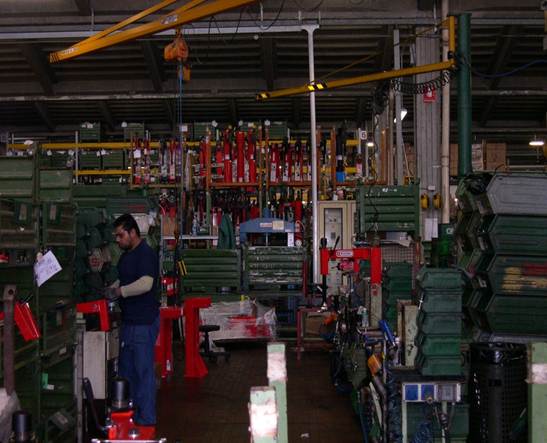
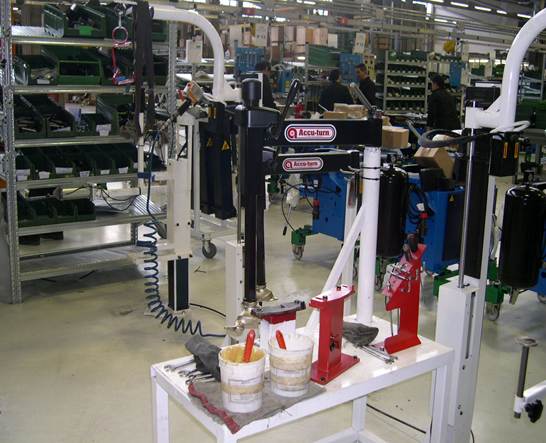
The transformation of this production department is evident at first glance. Before the intervention, the workstations were unbalanced and not logically arranged, and above all, they were very poorly maintained – disorder and dirt could be observed everywhere. After just 8 weeks of intervention (on the right), the situation appears completely different. The workstations are balanced, flowing, well-maintained, and efficient, and the material lying around (raw materials and semi-finished products) has significantly decreased. All of this has translated into reduced, stable, and constant cycle times.
-

- A worker stands in a workshop surrounded by stacks of green metal parts and various tools. Amidst industrial equipment, shelves laden with red tools, and overhead cranes, the scene reflects a bustling production environment where value stream mapping enhances efficiency.
-
- A factory environment with industrial equipment, including a robotic arm labeled “Acro Blue” and “Acro Betts,” exemplifies lean manufacturing. Shelving holds various tools and components, and workstations are present. Buckets and tools sit on a table in the foreground, optimizing the value stream map for efficiency.
Cleaner and tidier work environment
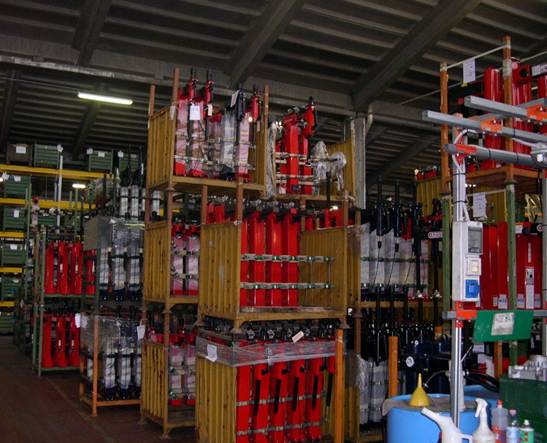
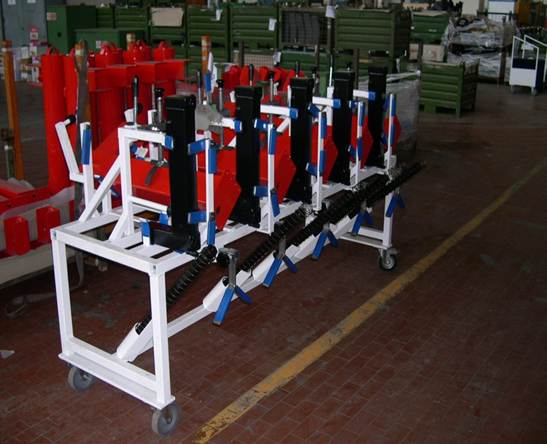
In this case too, the shift from “make-to-stock” production to a “syncro” model highlights some fundamental improvements. The extremely high cost due to large inventories (resulting in space occupation and the need for complex coding and handling) has drastically reduced thanks to Lean intervention. Four months after the start of the consulting project, the maximum WIP observed in the factory has never exceeded 6 units, a value clearly unthinkable just a short time ago (see photo on the left). The work environment has also become decidedly cleaner and more orderly, to the satisfaction of all operators.
-
- A warehouse filled with stacks of industrial machinery and equipment, including red and black components on wooden pallets, exemplifies lean management.
-
- The industrial equipment, with its metal frame and red and black components, embodies lean Six Sigma principles. Mounted on wheels in a workshop with a red tiled floor, it reflects an efficient design aimed at minimizing lead times while maximizing productivity.
Right first time
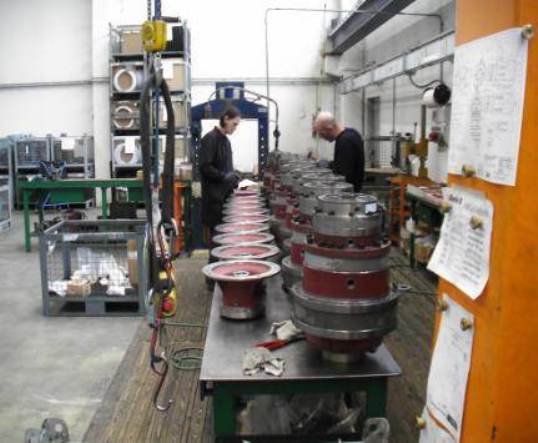
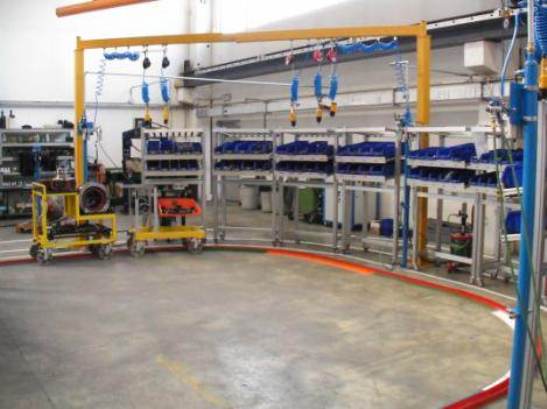
In this striking example of Lean implementation, WIP has practically disappeared from the line. Today, by assembling one product at a time in a continuous flow, there is no longer any material waiting between workstations (see photo on the left). The project team has thus freed up a great deal of floor space, which has been reorganized and equipped in an efficient and rational manner. In addition to a dramatic reduction in lead times, this has allowed for greater control over the process, resulting in a significant increase in quality in terms of “first-pass yield.”.
-

- In a busy workshop, two people are standing at a long table, examining a row of large mechanical parts. Embracing the principles of lean manufacturing, the room is filled with tools and machinery, while the walls are lined with equipment and diagrams. Nearby, a metal bin efficiently holds supplies.
-

- An industrial assembly line installed in a factory, featuring metal frames, conveyor belts, and blue bins optimized through lean management production. The area is organized for efficient manufacturing with suspended tools and workstations, minimizing lead times and improving workflow efficiency.
Why is Lean Thinking crucial for businesses?
Lean Thinking enables you to:
- Creating real value for the customer: focusing exclusively on what the customer perceives as value, eliminating superfluous activities.
- Eliminate waste (Muda) by identifying and eliminating the seven types of waste (overproduction, waiting, transportation, overprocessing, inventory, motion, and defects).
- Continuous improvement (Kaizen): triggering a virtuous cycle of optimization that leads to ongoing reductions in time, costs, and resources.
- Increase operational efficiency optimizing processes from start to finish, from design to delivery.
- Promoting a cultural shift: empowering staff and fostering a proactive, problem-solving mindset.
Adopting Lean Thinking means choosing to be a dynamic, innovative, and modern company, ready to compete in a constantly evolving market. It is an investment that pays off in terms of productivity, quality, customer satisfaction, and lasting competitive advantage. To understand how Lean, sustainability, and digitalization come together to tackle global challenges, Download the White Paper: “Lean, Sustainability, and Digitalization Team Up!”.
As we've said, perfection isn't a destination, but a guiding horizon for an incessant cycle of identifying and eliminating new waste. This includes adopting new technologies as key enablers. To understand how Value Stream Mapping integrates with technological innovation, discover “Lean Thinking: Business Transformation Through Value Streams and 5G Technologies”.
Frequently Asked Questions about Lean Thinking
Lean Thinking is a philosophy or a mindset focused on maximizing customer value while minimizing waste. It's a broader concept applicable to any industry or organization. Lean Manufacturing, on the other hand, is the application of Lean Thinking principles specifically within a manufacturing environment to improve production processes and eliminate inefficiencies.
Lean Manufacturing is the application of Lean principles within the industrial production sphere. Lean Thinking is the broader paradigm that extends them to any organizational context: offices, services, supply chain, R&D. Manufacturing is one of the applications; Thinking is the underlying philosophy.
Does Lean Thinking apply only to large companies?
No. Lean Thinking is particularly effective in SMEs, which can apply it with greater agility and speed compared to large organizations. In Italy, most Lean transformation projects concern medium-sized businesses.
Where do you start to introduce Lean in a company?
The starting point is always Value Stream Mapping: first, observe where waste is concentrated, then intervene methodically. Starting with tools without understanding the flow is the most common mistake.
How long does it take to see results from a Lean project?
The first visible improvements -- reduction of clutter, balancing of workstations, reduction of WIP -- can be observed within the first 8-12 weeks. Structural and measurable results on company KPIs generally require 12-24 months of continuous project work.
Are Lean Thinking and digitalization compatible?
They are not just compatible: they enhance each other. Lean eliminates process waste before technology automates it — digitizing an inefficient process just makes waste faster. The correct approach is to streamline first, then digitize.
The next step
Knowing the principles of Lean Thinking is the starting point. The leap in value occurs when these principles become a real project, with defined methods, people, and timelines.
Learn more about the theory
- Practical recommendations for implementing a Lean project
- Lean Tools: Operational Techniques to Support the Project
- Lean Applications: From Manufacturing to the Office
From knowledge to implementation
Bonfiglioli Consulting supports Italian SMEs in their Lean transformation through its proprietary Lean World Class® method. Discover transformation programs at bonfiglioliconsulting.com
