



Optimize your processes with the lean approach
Value Stream Mapping (VSM) is the Lean tool for visualizing the entire flow of a process—from supplier to customer—identifying value-adding activities and those that represent waste. It is not a traditional flowchart: VSM includes both the physical flow of materials and the flow of information that governs it, providing a systemic view that no other Lean tool can offer.
In the method Lean World Class® developed by Bonfiglioli Consulting, The VSM is the mandatory starting point for any transformation project: first, you see the flow in its entirety, then you decide where and how to intervene.
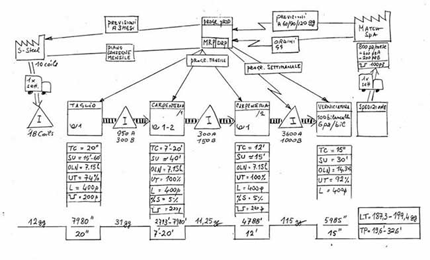
How does Value Stream Mapping work?
The VSM is implemented in two distinct and sequential phases.
Current State Map
Starting from the customer order, the entire process is traced backward to the supplier, mapping each stage with its relevant data: cycle times, waiting times, intermediate stock, number of operators, and defect rates. The result is a visual representation that shows where value is created and where waste accumulates.
Future State Map — the future state project
Based on the current state, the ideal flow is designed: elimination of priority waste, inventory reduction, phase synchronization, and simplification of information flows. The Future State Map is not a theoretical exercise—it's the operational plan for the Lean transformation, with defined actions, responsibilities, and timelines.
When to apply Value Stream Mapping
VSM is the tool to use before any other Lean intervention, because it provides the necessary overview for methodical intervention. It is applied when:
-
It is unclear where the greatest waste is concentrated in the production or administrative process.
-
Previous interventions have produced local improvements without impacting overall lead time
-
You want to design the future state of the flow before deciding which tools to use and in what sequence.
-
It is necessary to align management and operational teams on a shared vision of the actual process
VSM is applied in manufacturing, logistics, and administrative contexts. Wherever there is a flow—of materials, information, or practices—VSM can make it visible and improvable.
Application examples
In a manufacturing context, a typical VSM reveals that a product’s lead time consists of 90–95% waiting, transportation, and inventory—activities that add no value for the customer. Identifying this proportion using actual data is often the moment when management truly grasps the extent of the potential for improvement.
In administrative and service contexts, VSM applied to offer, purchase, or case management processes yields similar results: redundant information flows, unnecessary approvals, and interdepartmental waits that multiply overall time without adding value.
The most common errors in applying VSM
-
Map too much detail — The VSM is a systems thinking tool, not an operational procedure. Descending to the level of individual micro-operations produces illegible maps that lose sight of the overall flow.
-
Stopping at the current state without designing the future state — Mapping the current state without designing the future state turns the VSM into an exercise in diagnosis for its own sake. The value lies in the resulting transformation plan.
-
Do not map the information flows — The VSM includes both the physical flow of materials and the flow of information. Ignoring the informational part produces an incomplete map and a partial improvement plan.
-
To implement it only with the managers, without the operators — those who work in the process know the real-time conditions, variations, and problems that don't emerge from system data. A VSM done only in a meeting room is often far from operational reality.
-
Use it as a document instead of a work tool — The VSM must be displayed, updated, and actively used in project management. Archived in a PowerPoint folder, it loses all its operational value.
VSM in the Lean World Class® Method
In the Lean World Class® method, Value Stream Mapping is not a preliminary activity to be filed away: it is the compass that guides the entire transformation project. The Future State Map becomes the shared reference between management and operational teams for every improvement decision.
Want to see how VSM is applied in a real project? Discover the method Lean World Class® developed by Bonfiglioli Consulting
