



Fostering Flow in Lean Thinking – The Power of Continuity
After understanding the essence of value The first principle of Lean Thinkingand mapped and streamlined the value stream Identifying and eliminating wastethe second principle), we are facing the third and crucial step: Make the Flow slide. This principle represents the beating heart of the Lean system, transforming individual activities into a continuous, uninterrupted flow, maximizing efficiency and drastically reducing time and waste.
Lean Thinking, at this stage, overturns traditional operational logic, based on “batches,” “functions,” and isolated “offices.” The objective is clear: to ensure that products, services, or information move unimpeded through the entire process, from raw material or initial idea to the finished product or service delivered to the customer. The aim is for smooth and continuous production, where each stage immediately passes to the next.
Understand the importance of uninterrupted flow
In the context of Lean, the term “flow” does not refer only to physical movement, but to the synchronized and harmonious movement of materials, information, and labor through the entire production or service delivery process. When the flow is uninterrupted, each stage of a process is completed and immediately moves to the next stage, without delays, inventory build-ups, or blockages.
Implementing an effective workflow leads to a significant reduction in cycle timelead time). This is the total time required to transform raw materials into a finished product ready for the customer. The fewer disruptions, the faster the product throughput time along the value chain. This results in a much quicker response to customer needs and a clear increase in market competitiveness.
Practical Applications and Benefits of Continuous Flow
Achieving a continuous flow in production or service delivery requires targeted and often radical interventions. Let's look at some of the practical applications and their resulting benefits:
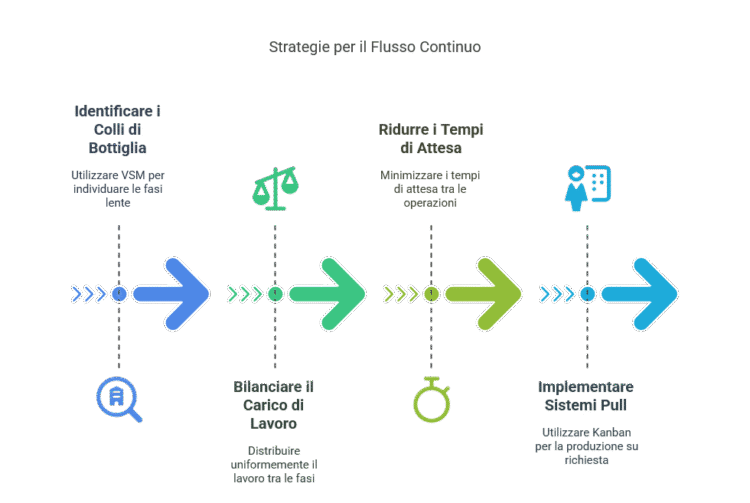
- Bottleneck eliminationthe first step to streamlining the flow is to identify and mitigate “bottlenecks,” which are those points in the process that limit the overall speed. Through tools such as Value Stream Mapping (VSM), ...the slowest or overutilized phases are identified. For example, in a factory, a specific machine with a lower capacity than the others could represent a bottleneck that slows down the entire line. Intervention could consist of optimizing its efficiency, adding capacity, or reallocating work.
- Workload BalancingHeijunka)It is fundamental to balance the workload across the different stages of the process to avoid over-burdening some areas while others remain idle. This means distributing production evenly over time, avoiding peaks and valleys. For example, balancing assembly activities so that each station receives a constant flow of parts, rather than intermittent batches, prevents build-ups and downtime.
- Reduction of waits (Motion and Waiting) Muda)Minimizing waiting times between operational steps is crucial. Every wait is a waste. In a manufacturing context, this can mean reorganizing the factory layout to reduce transport distances between workstations or synchronizing operations so that a part is ready for the next stage as soon as the previous one is completed.
- Implementation of Pull Systems: To facilitate a continuous flow, “pull” systems are adopted instead of “push” systems. In traditional push systems, production is based on forecasts and pushes materials along the chain, often generating accumulations. With a pull system, products or materials are requested by the next stage only when it actually needs them, reducing inventory buildup and ensuring that only what is actually consumed or requested by the customer is produced. A classic example is the Kanban, where a visual signal indicates the need to restore a particular item.
Examples of companies that have effectively implemented flow
The application of the “Flow State” principle has been fundamental to the success of numerous companies across various sectors:
- The Japanese automotive industryA prime example is a famous Japanese automotive company, a pioneer of Lean manufacturing. Its ability to maintain an almost uninterrupted production flow, from body assembly to painting, from final assembly to shipping, is legendary. This was achieved through careful synchronization of operations, elimination of intermediate lot sizes, and intensive use of pull systems and automation with a human touch (Jidoka), which allows the line to be stopped in case of anomalies to resolve them immediately. This has drastically reduced waste and enabled real-time responsiveness to changes in consumer demand.
- Electronic productionIn the electronics manufacturing sector, companies that adopt continuous flow are able to drastically reduce production cycles, moving from design to mass production in record time. Flow optimization minimizes delays between various stages, from component insertion to final testing, while ensuring high-quality standards and greater flexibility in launching new products.
Conclusion: Flow as the driver of value
Enabling flow is a crucial pillar of Lean Thinking that, once applied, can radically transform a company's operational efficiency. It's not just about speed, but a virtuous combination of rapidity, quality, and flexibility. The ultimate goal is to deliver value to the end customer in the leanest, most effective, and continuous way possible, eliminating friction and interruptions. This principle encourages constant attention to the movement of processes, recognizing that smooth flow is synonymous with less waste and greater productivity.
You've understood this principle, but you want an overview? Back to the Complete Guide to Lean Thinking and learn about all the other key concepts.
Do you want to see how this principle applies in a real project? Discover the Lean World Class® method developed by Bonfiglioli Consulting
