



Identify the Value Stream in Lean Thinking – The Key to Unprecedented Efficiency
In the heart of Lean Thinking the relentless pursuit of value and the elimination of everything that doesn't create it. Among its fundamental principles, the Second, “Identify the Value Stream”, it proves to be an indispensable compass for any organization aiming for operational excellence. But what exactly does “value stream” mean, and how can its correct identification revolutionize processes?
This crucial principle invites us to explore every single activity within a process, from the conception of an idea to the final delivery to the client, to discern what truly contributes to the creation of value from what, however, it represents one waste. It's a magnifying glass that reveals hidden inefficiencies, allowing companies to operate more leanly, rapidly, and effectively.
Deeply understand the Value Stream: not just a concept, but a revolutionary perspective
The value stream (o Value Stream) is not simply a list of steps; it is the entire sequence of actions, both value-added and non-value-added, necessary to bring a product or service from its starting point (raw materials or initial idea) to the customer's hands. This holistic view is what distinguishes the Lean approach: instead of focusing on isolated individual phases, the entire system is observed.
Why is this perspective so powerful? Because it allows us to identify interdependencies, bottlenecks, and, most importantly, the Waste which often lurk between one phase and another, invisible to those who only look at things in a fragmented way. Thinking about the value stream means:
- TransparencyMake each step visible.
- Contexthelps understand how each activity fits into the bigger picture.
- Customer FocusHighlight what the customer perceives as value.
The three fundamental categories of activity
When analyzing the value stream, it is essential to classify activities into three distinct categories to understand where value is generated and where waste is lurking:
- Value-creating activities Value-Added (VA)These are actions for which the customer is willing to pay. They directly transform the product or service, adding features or functionalities that the customer desires. Their cost can be passed on to the customer.
Example – The assembly of an electronic component, the processing of a raw material into a semi-finished product, the painting of a finished product. - Activities that don't create value but are necessaryNon-Value-Added but Necessary – NVA-N)These activities do not directly add value to the product or service from the customer's perspective, but they are considered indispensable with current systems, regulations, or technologies. The goal is to minimize them or make them more efficient.
Example – Quality inspections (if they don't reduce defects but only detect them), preparation of mandatory shipping documents, periodic calibration of complex machinery. - Non-Value-Added and Unnecessary Activities (NVA-U)these are the pure wasteMuda) and they should be eliminated immediately. They add no value for the customer and are not necessary for the current operation of the process.
Example – Wait times, overproduction, unnecessary movement of materials or people, defects requiring rework.
Practical Applications: Value Stream MappingValue Stream Mapping
The most effective way to identify and analyze a value stream is through a visual technique called Value Stream Mapping. This methodology allows for:
- Display the entire processfrom the initial customer request to the final delivery, including information stages and material flows.
- Identify waste (Muda)Waiting, transportation, overproduction, defects, unnecessary motion, excess inventory, and unnecessary processes.
- Detect bottlenecksBottlenecks.
- Develop an ideal future stateDesign an improved process that eliminates waste and optimizes flow.
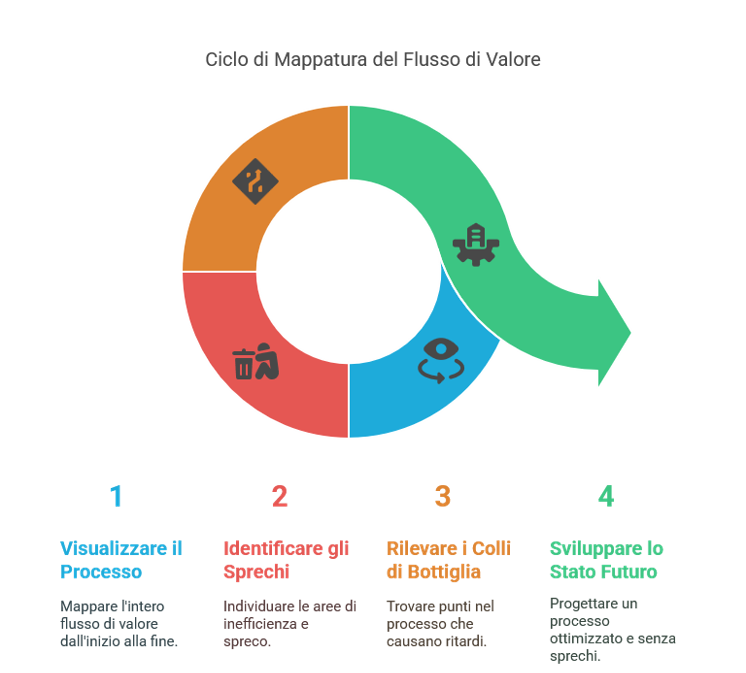
The VSM typically focuses on three main flows within an organization, covering most business activities:
- Product Design/Development Flow: from the conception of the idea to the final design and prototyping (for a structured approach, read the article “Product Optimization with Lean Product Design”).
- Order Management Workflowfrom receiving a customer order to its processing and planning.
- Production flow of goods/delivery of servicesfrom the transformation of raw materials to the delivery of the product or service to the customer.
Concrete examples of Value Stream application
To fully understand the impact of value stream identification, let's look at some practical examples across different sectors:
Example 1: an electronic component manufacturer
Imagine a company that produces electronic boards. Through a VSM analysis of their production flow, the company discovers that:
- Transportation wastethe components are moved multiple times between different departments, often over long distances.
- Wasted waitingSemi-finished products wait days in the warehouse before being processed by the next machine.
- Waste of defectsA high percentage of boards must be reworked due to errors in the initial soldering process.
Solutions and benefits:
- Layout ReorganizationThe arrangement of machines and departments is reorganized to drastically reduce transport times and distances.
- Continuous Flow“Pull” production systems are implemented to reduce waiting times and intermediate stocks, producing only what is required.
- Quality Improvement at the SourceInvestment is made in operator training and preventive machine maintenance to reduce defects.
Result: Production times reduced by 30%, transportation costs cut in half, and a significant reduction in defect rates, with a direct impact on customer satisfaction and profitability.
Example 2: A furniture factory and the production lineAssembly
Let's consider a furniture factory that produces custom cabinets. Value stream analysis of their assembly line might reveal:
- Wasted motionoperators must walk excessively to retrieve tools or components from distant storage areas.
- Stock wasteexcessive accumulation of panels and semi-finished hardware between one stage and another, occupying space and tying up capital.
- Wasted waitingThe drilling phase must wait for the panel cutting phase to be completed for an entire batch, causing long downtimes.
- Waste of defectspieces cut poorly or drilled inaccurately, requiring rework or scrap, generating additional costs.
Solutions and benefits:
- Implementation of ergonomic workstationsTools and components placed within easy reach of operators to reduce unnecessary movements (5S principles).
- Just-In-Time Production (Just-in-time)reduction of intermediate stocks by producing and delivering components only when they are needed for the next stage.
- One-Piece FlowReorganization of the line to process one piece at a time or in very small batches, reducing waiting times between stages.
- Andon and JidokaIntroduction of systems to immediately report defects and stop production to correct them at the source, preventing defects from spreading.
Resultincreased assembly line productivity, reduced inventory space, decreased customer lead times, and a drastic reduction in rework and scrap costs, improving the overall profitability of the factory.
Undeniable Benefits of Value Stream Identification
A clear and in-depth understanding of the value stream is not just an analytical exercise, but a strategy that leads to tangible and lasting benefits for any organization:
- Cycle Time ReductionLead Time)By eliminating non-value-adding activities, processes become faster, allowing for greater agility in responding to market and customer demands.
- Quality ImprovementFocusing on value-added activities and removing waste means reducing error points and improving the consistency and reliability of the final product or service.
- Increased operational efficiencyresources (people, machinery, materials) are used more intelligently and effectively, reducing costs and maximizing productivity.
- Greater Customer SatisfactionA more efficient, faster, and higher-quality process directly translates into a product or service that better meets customer expectations.
- Reduced costEliminating waste means reducing the costs associated with materials, labor, energy, and space.
- Culture of Continuous ImprovementIdentifying the value stream is the first step to establishing a continuous improvement (Kaizen) mindset within the organization.
Conclusion: Value Stream as the Foundation of Lean Success
identifying the value stream is not an abstract theory, but a Practical and powerful method to discover what truly creates value in business processes and, above all, to eliminate what does not. It is a fundamental pillar of Lean Thinking that allows organizations to operate more efficiently, to be more responsive to market changes and customer needs, and to build a solid foundation for long-term competitiveness.
Understanding and mapping the value stream is the starting point for any successful Lean journey. If a company aims to reduce waste, improve quality, and accelerate processes, beginning by identifying the value stream is the most strategic move.
You've understood this principle, but you want an overview? Back to the Complete Guide to Lean Thinking and learn about all the other key concepts.
Do you want to see how this principle applies in a real project? Discover the Lean World Class® method developed by Bonfiglioli Consulting
