

- Summary
- What is Kamishibai? Definition and origin of the method
- How the Kamishibai system works: the logic of a glance
- Where Kamishibai is applied in companies: 5S, safety, and processes
- Kamishibai and 5S: how to keep the fifth S alive over time
- When is it convenient to introduce a Kamishibai system?
- Startup Check vs. Layer Process Audit (LPA): What are the differences?
- How a Kamishibai card is made: structure and colors
- How to perform a step-by-step startup check
- Layer Process Audit: How the Next Level Works
- How to update LPA checkpoints over time
- From the red card to closing: how to handle a problem with Kamishibai
- Root Cause Analysis and 5 Whys: How Kamishibai Leads to the Root Cause
- Why does Kamishibai reinforce leadership on the Gemba
- Kamishibai Multi-site: A Case of Maturity Assessment
- How is the cross-evaluation between plants concretely carried out?
- The Lean Maturity Scale: How to Measure Your Achieved Level
- Why a multi-layered audit works better than an isolated check
- Frequently Asked Questions about Kamishibai in Lean Management
- What is Kamishibai in Lean Management?
- What is the difference between a Start Up Check and a Layer Process Audit (LPA)?
- In which areas of a business is Kamishibai used?
- How do you handle an anomaly detected with the Kamishibai?
- When is it advisable to introduce a Kamishibai system in a company?
- Kamishibai: A Simple Tool for Lasting Discipline
By the Editorial Staff of Bonfiglioli Consulting
Every publication stems from industry studies, field research, and global trend analysis, integrated with the knowledge and expertise gained from transformation projects, with the aim of promoting a business culture.
Published 07/27/2026
Summary
The Kamishibai it is a tool for Visual Audit of Lean Management which allows for regular verification of compliance with operating standards directly on the gemba. The article illustrates how the system works, from the structure of the two-color green/red cards at the two audit levels — Start Up Check e Layer Process Audit — up to anomaly management with the 5 Why and the Root Cause Analysis. The contexts in which it is most useful to introduce it are also described, along with an application case in a specific context. multi-plant, to show how Kamishibai can transform the enforcement of standards into a a lasting and shared discipline at all levels of the organization.
The Kamishibai is a visual audit tool used in Lean Management which allows team leaders and managers to regularly verify compliance with operational standards directly on-site. This article explains how the system works, starting with its Japanese origins and moving on to practical applications within a company: from the structure of the two-color (green/red) check sheets to the different audit levels (Start-Up Check and Layer Process Audit), including the structured management of anomalies through the 5 Whys and Root Cause Analysis. It also illustrates the contexts in which it is most useful to implement the system, the differences among the various organizational levels involved, and a case study in a multi-plant setting. The ultimate goal is to demonstrate how Kamishibai—simple in form but powerful in effect—can transform standard compliance from an occasional activity into a lasting discipline shared at all levels of the organization.
Kamishibai is a visual audit system that allows team leaders and managers to regularly verify compliance with operating standards directly on gemba, the area where the work is done. The term comes from Japanese and literally means “illustrated story” or “paper theater”: in ancient Japan, Buddhist monks used illustrated scrolls (makimono) to convey moral teachings to an often illiterate audience, through images accompanied by oral narration. In the Lean and Operations world, this metaphor has been transformed into a concrete system of control boards., today used in numerous production plants to make compliance with standards visible.
What is Kamishibai? Definition and origin of the method
At its core, Kamishibai it's a simple card check system used to systematically review the critical elements present in a work area. Each card describes a specific control point—a machine parameter, a safety condition, a 5S rule—and is assigned according to a predetermined schedule to a precise level of the organizational structure: daily for the team leader, weekly or monthly for higher levels.
This definition is also confirmed internationally: the Lean Enterprise Institute describes Kamishibai board as a visual control tool that makes the difference between normal and abnormal conditions in a process immediately clear and identifiable, integrating the principle of Go and see for yourself — the “go and see for yourself” — in the standardized management routine. The Dutch Lean Institute defines it similarly as a real-time visual control mechanism for executing audits along the process.
How the Kamishibai system works: the logic of a glance
What makes Kamishibai particularly effective, compared to a traditional audit managed by an external function, is that the check is carried out personally by whoever manages the area on a daily basis. This produces some distinct and observable effects in the projects carried out: it reinforces discipline in the punctual execution of required checks, speeds up the immediate correction of any anomalies found during the audit, contributes to the improvement of product quality and process effectiveness, and increases management's involvement in daily operational management.
The underlying mechanism is that of a glance: A card displayed with the green side communicates compliance, a card displayed with the red side immediately communicates an open anomaly., without needing to consult reports or information systems.
Where Kamishibai is applied in companies: 5S, safety, and processes
One of the most relevant aspects of Kamishibai, often underestimated, is that it is not a tool reserved for quality in the strict sense. It is a cross-cutting method, applicable to any field where there is a measurable standard that can be physically verified in the field. The most common application areas include production processes, equipment, issues reported by external or internal customers, machine parameters, supplier-related criticalities, standardized work, safety, 5S, and operational documentation.
Kamishibai and 5S: how to keep the fifth S alive over time
It's no coincidence that 5S appears among the most frequent application areas. As explained in Lean Thinking 5S Guide, the system is based on five steps—Sort, Set in order, Shine, Standardize, and Sustain—and without constant oversight through periodic audits, the fifth S, “Sustain,” risks remaining an intention rather than an established practice, turning 5S into a project with an expiration date instead of a permanent management system. Kamishibai is precisely the tool that allows this provision to continue over time.
This wide range of applications means that the same system can simultaneously manage multiple families of Kamishibai—one dedicated to safety, one to quality, one to production, one to 5S—each with its own board, its own color coding, and its own verification frequency.
When is it convenient to introduce a Kamishibai system?
Not all areas require the same level of monitoring. The most frequent triggers that justify the introduction or reinforcement of a Kamishibai system include themes related to quality and standardized work, issues classified as business critical, prolonged periods of missing targets for customer parts-per-million indicators, an unstable quality level on the production floor, customer audit results that need improvement, and negative performance of production indicators such as’First Time Through.
In summary, Kamishibai is particularly useful when an organization needs to transition from occasional, reactive control to a structured, visual, and proactive routine of operational oversight.
Startup Check vs. Layer Process Audit (LPA): What are the differences?
To make the system truly effective, Kamishibai is often translated into visual board with controls distributed across multiple levels of the organization. In practice, each management level has a different audit frequency and a specific role in overseeing standards.
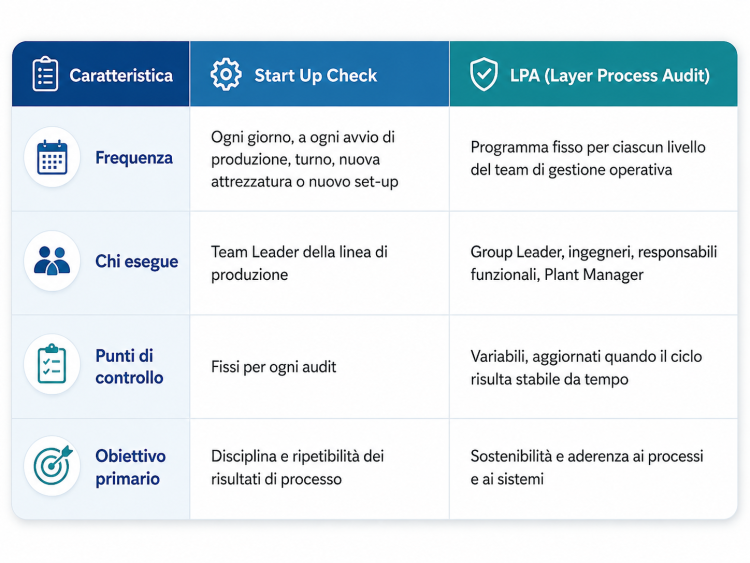
The Startup Check is generally tied to the line and the startup moment, so it is carried out daily or whenever operating conditions change, such as a new shift or a new setup. The LPA, on the other hand, follows a defined schedule for management levels and can be weekly, bi-weekly, or monthly depending on the organization.
Roles also change. The Start Up Check is usually assigned to the line Team Leader, while the LPA involves higher-level figures such as Group Leaders, functional managers, engineers, or Plant Managers.
In summary:
-
lo Start Up Check It guards the line in everyday life;
-
the’LPA maintains system stability across different management levels.
This multi-level structure helps keep standards visible, catch anomalies earlier, and make control part of everyday management routine.
The following table summarizes the main differences between Start Up Check and LPA.
The experience gained in a project with a client from automotive sector has clearly shown the usefulness of structuring standards oversight across multiple organizational levels.
In this case, the entire audit system was organized on physical boards differentiated by level: one dedicated to daily line monitoring, one for weekly or bi-weekly process team monitoring, and one for monthly plant-level monitoring. This multi-level architecture—known as “layered audit” ensures that every level of the organization uses the same system of standards, but with a different degree of depth and frequency based on the role
How a Kamishibai card is made: structure and colors
The operational heart of Kamishibai is the physical card, organized on two sides with distinct functions. The first side contains the control identification information: line reference, verification questions, shift, description of the checked item, release date, list of affected workstations, auditor's name, and audit day. The second side shows the visual references for carrying out the check, the general rules applicable, and a frame color code, which visually identifies the theme to which the card belongs: one color for safety, one for quality, one for production, one for 5S. Color logic can naturally be adapted to the internal conventions of each company.
This encoding is not an aesthetic detail: it allows anyone passing by a Kamishibai board, even without stopping to read the details on the cards, to understand immediately which topics are under control and which require attention.
How to perform a step-by-step startup check
In practice, the Team Leader takes the card assigned to the current shift and physically goes to the indicated checkpoint. Here, they compare the requirements described on the card with the observed situation, based on direct physical evidence. If the condition is compliant, the card returns to the board with the green indicator highlighted, and production can proceed. If an anomaly arises, the card is displayed with the red indicator, and when the problem cannot be resolved immediately, a linked problem resolution card is opened.
A recurring operational rule in these systems states that production start-up is conditional on the positive outcome of all checks, or on the documented acceptance of any anomaly through a containment action. This constraint transforms the Kamishibai from a simple detection tool into a true quality gate. at the start of the production process.
Layer Process Audit: How the Next Level Works
The Layer Process Audit follows an execution logic similar to the Start Up Check, but at a higher organizational level and with checkpoints that vary over time. The process involves collecting the card according to the weekly schedule, physically moving to the audit point, visual verification against expected requirements, and repositioning with the color corresponding to the outcome.
An interesting operational difference concerns anomaly management: in LPA, besides displaying the card with the red reference, the exact location of the problem on a plant layout map is often also indicated. This creates, over time, a visual representation of the distribution of critical issues, useful for identifying recurring patterns in specific production areas.
How to update LPA checkpoints over time
An additional rule states that if a checkpoint tests positive for an extended period (typically several months), it may be removed from the weekly verification cycle, provided the overall quality level of the area allows for it. Conversely, every customer report automatically generates a new audit item to be monitored.
From the field experience gained in the projects carried out, it emerges that the complete implementation of an LPA system requires time, mainly for the organization of equipment and learning the correct ways to manage corrective actions. However, the results become visible both internally and in customer relations, and once the system is consolidated, it is simple to use and capable of concretely improving perceived quality.
From the red card to closing: how to handle a problem with Kamishibai
When an anomaly detected during a Kamishibai check cannot be immediately resolved, the system links to a structured problem-solving path through a dedicated problem resolution card. The typical workflow involves the opening of a card by the person who detects the problem, recording the description, date, and responsible party. If necessary, an immediate containment action is activated to continue operations safely. The responsible party monitors progress during periodic reviews until the permanent solution is implemented and the card can move to the closed status. Only after formal verification of the effectiveness of the action, carried out by an authorized level, is the card removed from the board.
Root Cause Analysis and 5 Whys: How Kamishibai Leads to the Root Cause
The most structured component of the problem resolution process is the Root Cause Analysis, typically conducted using the technique of 5 Whys. As described in the Lean Tools Guide In Lean Thinking, this technique serves to overcome the analysis of superficial symptoms, digging level by level to identify the real root cause of a problem — a principle that Bonfiglioli Consulting systematically applies in their industrial problem-solving processes, aimed at identifying root causes and optimizing processes. A typical example applied in maintenance concerns recurring machine downtime: starting from the observed symptom—the unexpected stoppage of a station—a progressive investigation can lead to discovering that the root cause is not the failure of the component itself, but a lack of preventive maintenance activities on that specific point of the plant, a very common pattern in Root Cause Analysis applications in the industrial field.
This step is crucial: the Kamishibai not only flags the anomaly but also ensures that a problem's closure only occurs after a formal verification of the solution's effectiveness, preventing critical issues from being archived without a real resolution.
Why does Kamishibai reinforce leadership on the Gemba
Beyond the technical component, Kamishibai has a significant impact on how leadership is concretely exercised in the field. The system requires managers at every level—from Team Leader to Plant Manager—to leave their offices and physically be present at the gemba with a regular and predictable cadence.
Kamishibai can be considered an operational tool within the broader approach to Leader Standard Work, as described by Lean Thinking as the discipline that makes the presence of managers at the gemba a planned, verifiable activity not left to individual discretion, connecting gemba, coaching, continuous improvement daily accountability in a single leadership routine.
This approach fits into a broader logic of daily objective management, structured across multiple levels of responsibility: from frontline operators and team leaders, to group leaders, and finally to plant-wide cross-functional leadership. In this diagram, each level has its own visual board positioned as close as possible to the point where the work is actually performed, and is responsible for managing the escalation of anomalies that it cannot resolve independently within the agreed-upon timeframe.
An interesting element of this approach is the “no blame, no shame” principle: leaders are called upon to direct questions toward “why” a problem occurred, rather than “who” caused it, in order to build a safe culture where people feel free to report anomalies without fear of personal repercussions.
Kamishibai Multi-site: A Case of Maturity Assessment
A particularly advanced application of Kamishibai, observed in a multi-site industrial group setting, involves using the method not only for line audits but also as a tool to assess the overall Lean maturity of a plant, as part of an inter-site cross-evaluation program.
In this model, plant managers act as evaluators for sites other than their own, based on the logic that those who have personally faced certain operational problems are in the best position to recognize and assess them elsewhere. The program includes on-site training for evaluators and a periodic cycle in which each plant undergoes cross-evaluation multiple times a year. The stated goal is clear: the tool is not designed to add control or put pressure on the plants, but to consolidate the sharing of know-how and best practices between different sites, developing common problem-solving tools and creating network synergies.
How is the cross-evaluation between plants concretely carried out?
The process typically includes a preparation phase, where the local manager shares the activity schedule in advance along with their self-assessment against the benchmark standard. This is followed by an on-site review, which includes an initial briefing with the plant management and a meeting with the coordinators of the various Lean methods. Each coordinator presents the principles and practical applications of their respective areas. The evaluator's ultimate goal is to understand how deeply Lean methods are integrated into the plant's daily activities, rather than just being simple demonstration exercises.
The Lean Maturity Scale: How to Measure Your Achieved Level
The maturity level achieved by each area is measured through a progressive scale, ranging from an initial phase where improvement projects are born without a structured framework, to an advanced level where involvement occurs through improvement activities spread throughout the organization, with acquired knowledge systematically propagating to every level. In the intermediate levels, the assessment progressively considers the organization's ability to select projects based on consistent data, to extensively use visual boards, and to horizontally disseminate the acquired methodology.
Why a multi-layered audit works better than an isolated check
The added value of an integrated approach—Startup Check, LPA, and Problem Resolution combined in the same Kamishibai logic—becomes clear when the different levels are viewed as a single system and not as separate tools. In the cases analyzed, daily line oversight, periodic process team oversight, and longer-interval plant-level oversight integrate into a single flow, where any anomaly that cannot be resolved at the level at which it is detected automatically feeds into a shared problem management system.
This architecture guarantees two things simultaneously: on the one hand, no level of the organization is excluded from upholding the standards; on the other hand, each level focuses on its own area of expertise without burdening the higher levels with controls that could be managed more effectively further down the structure.
Frequently Asked Questions about Kamishibai in Lean Management
What is Kamishibai in Lean Management?
Kamishibai is a visual audit system that allows team leaders and managers to regularly verify compliance with operational standards directly on the gemba. It is based on two-color cards—green for compliance, red for non-compliance—distributed across multiple organizational levels with varying audit frequencies.
What is the difference between a Start Up Check and a Layer Process Audit (LPA)?
The Start-Up Check is performed by the Team Leader on a daily basis, at the start of each shift or whenever there is a change in setup. The LPA, on the other hand, involves higher levels of management—Group Leaders, functional managers, and Plant Managers—on a weekly, biweekly, or monthly basis. The former oversees the production line on a day-to-day basis, while the latter ensures the stability of the system across the various management levels.
In which areas of a business is Kamishibai used?
Kamishibai is a cross-functional tool, applicable to any area where there is a measurable standard to be physically verified in the field: production processes, safety, 5S, quality, standardized work, machine parameters, operational documentation, and supplier management.
How do you handle an anomaly detected with the Kamishibai?
When an anomaly cannot be immediately resolved, a problem resolution ticket is opened with a description, date, and responsible person. A containment action is activated, a Root Cause Analysis is conducted using the 5 Whys, and progress is monitored until a permanent solution is found. The ticket is removed from the board only after formal verification of the corrective action's effectiveness.
When is it advisable to introduce a Kamishibai system in a company?
Kamishibai is particularly useful when an organization needs to transition from occasional, reactive monitoring to a structured, proactive routine. Key triggers include: quality instability on the production floor, negative customer audit results, poor performance on metrics such as FTT (First Time Through), and prolonged periods of missing targets for parts per million.
Kamishibai: A Simple Tool for Lasting Discipline
The Kamishibai proves to be a flexible and concrete tool, applicable to processes, safety, standard work, documentation, 5S, and problem management. Its strength lies in the combination of visual management, multi-level field audits, execution discipline, structured problem-solving through the 5 Whys, and formal verification of the effectiveness of corrective actions before closure.
This transition from written standards to standards actually enacted in daily practice is also central to the vision of Lean World Class® illustrated by Michele Bonfiglioli, according to whom “doing Lean” is no longer sufficient if an organization does not build a system capable of sustaining operational discipline over time. Kamishibai, in this sense, is a simple tool in form, with paper cards and physical boards, but powerful in its effects: it increases the visibility of critical issues, distributes responsibility across multiple organizational levels, and accelerates reaction speed, contributing in a measurable way to the continuous improvement of production processes.
